




ORGANS OF PARIS © 2026 Vincent Hildebrandt HOME ALL ORGANS


The parish of St Vincent de Paul was
established in 1802 and met in a dilapidated
premises until the construction of the present
church. The project of a new church was
entrusted to Jean-Baptiste Lepère (1761-1844),
who had accompanied Bonaparte to Egypt. He
quickly associated his son-in-law Jacques-
Ignace Hittorff (1792-1867) with the company.
The first stone of a basilica building was laid in
1824. But the economic crisis of 1826 and the
revolution of 1830 stopped the work. Finally,
in 1832, the project passed into the hands of
Hittorff, who remodeled it in his own way. The
church was consecrated in 1844.
The style of the church is inspired by ancient
Roman basilicas. The interior, with its
abundant decoration, has many works of art
designed by Hippolyte Flandrin, François Rude
,Charles-Laurent Maréchal.
The church is preceded by a square bearing
the name of Aristide Cavaillé-Coll!

C2
1851–1852
After submitting two proposals, Aristide Cavaillé-Coll was
commissioned to build the new grand organ, which was
inaugurated on 26 January 1852 by the titular organist Peters
Cavallo and Louis-James-Alfred Lefébure-Wély. It was on this
instrument that Jacques-Nicolas Lemmens performed several
times during February 1852 before an elite audience, astonishing
listeners with the perfection of his technique and the grandeur
and discipline of his style.
Cavaillé-Coll incorporated many innovative ideas in organ building,
including the use of piston chests (a system developed around
1845 by Eberhard-Friedrich Walcker of Ludwigsburg), glass panels
for the swell box, a differentiated layout of the windchests within
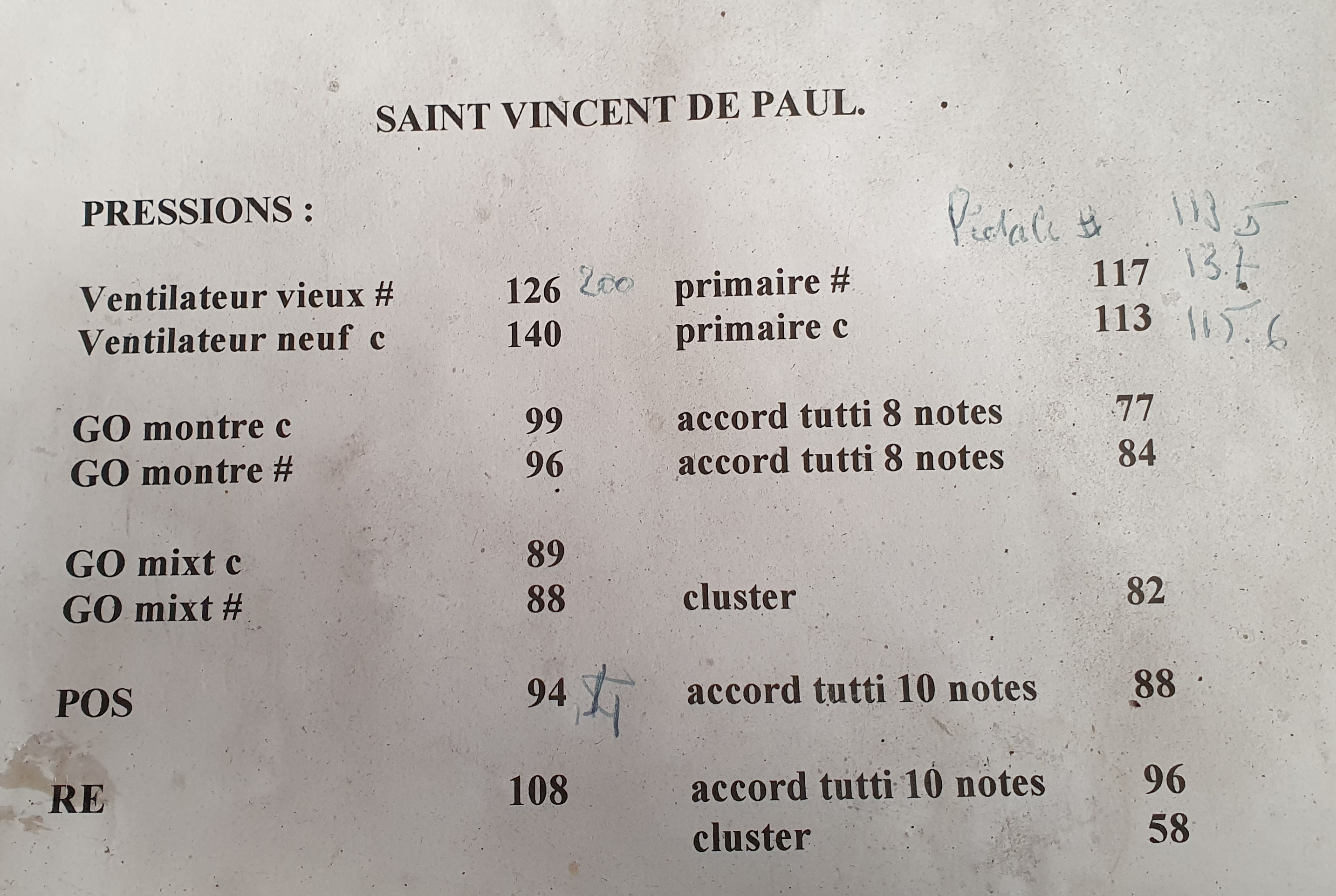
the two cases, and the application of different wind pressures.
The organ comprised 47 stops across three manuals of 54 notes
each and a German-style pedalboard of 25 notes.
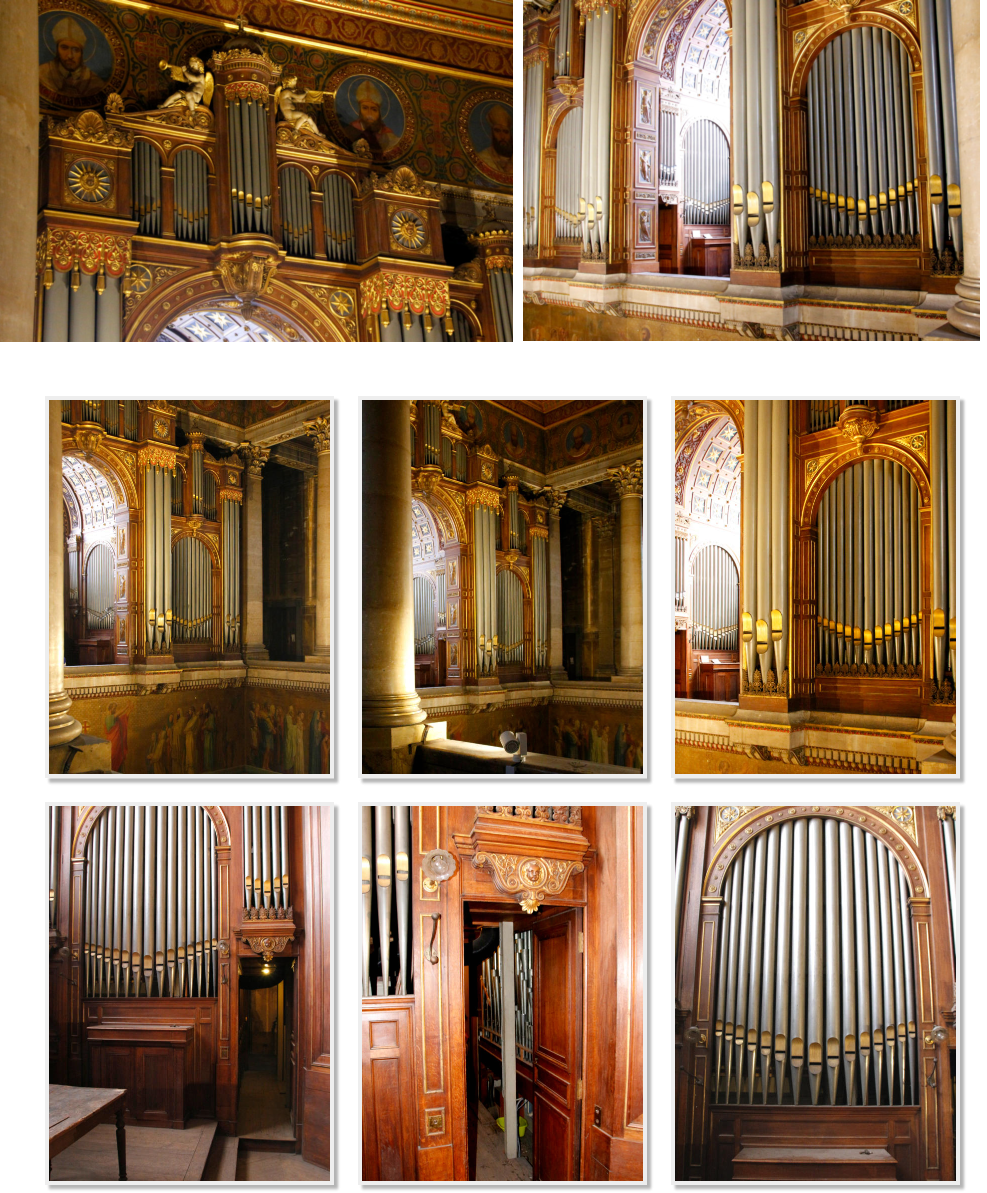
The case, designed by the church architect Jacques-Ignace Hittorff
and executed by Napoléon Liénard (sculpture) and Poncet
(woodwork), displays an original layout: two separate cases that
leave the rose window in full view along the central axis of the
façade.
The left case contains the pipework of the Positif and Récit, the UT
(C) chest of the Grand-Orgue’s Montre (Montre 16′, Gambe 16′,
Montre 8′, Gambe 8′, Montre 4′, Voix céleste 8′), and the UT pedal
chest. The right case houses the UT♯ (C♯) chest of the Grand-Orgue
Montre, the two chests for the other stops of the Grand-Orgue
(divided into bass and treble), and the UT♯ pedal chest. This
arrangement reflects Cavaillé-Coll’s extensive experimentation with
wind supply.
In addition to using Barker machines for couplers and stop action,
he placed the Montre ranks on two special valve chests with
different air pressures. The other Grand-Orgue stops were set on
two chests, each supplied with its own pressure level.
A cleaning and overhaul were carried out by Cavaillé-Coll between
1859 and 1863.
1927
Work was undertaken by Charles Mutin around 1927. The exact
nature of the intervention is unknown, but it likely included a
reversal of the first two manuals: the Positif (originally first)
became second, and the Grand-Orgue (previously second) was
moved to first position.
1961–1970
Organ builder Jean Hermann began enlarging the instrument and
electrifying the action. A fourth manual was planned—an
expressive Echo division featuring neo-baroque stops in a style
quite different from the original organ.
Following Hermann’s death in 1965, the work was continued by the
Gonzalez firm (Georges Danion). They restored and expanded the
organ, introducing neo-classical stops and revising the wind
system.
•
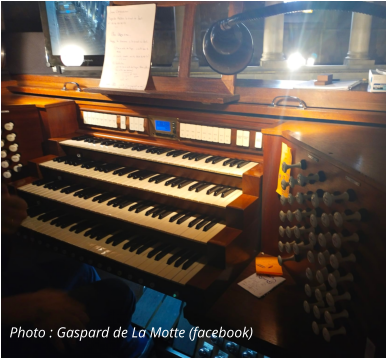
The key and stop actions were electrified.
•
A detached four-manual console, with pedalboard, was
installed on the side gallery, although the fourth division was
never built.
•
The manual compass was extended to 61 notes, and the
pedalboard to 32 notes.
Gonzalez returned in 1979 to clean the instrument after a fire in
the church in 1972.
1990
Major maintenance carried out by Marc Hedelin.
2009–2011
Bernard Dargassies carried out a major overhaul, dividing the
Grand-Orgue into two sections to create a Bombarde division on
the fourth manual. The transmission, combination system, and
stop controls were replaced, and the electric transmission
multiplied. Adjustments were also made to the wind system,
including the addition of a regulator for the Pedal.
After flood damage, Dargassies restored the Positif windchests
and performed another overhaul.
The Cavaillé-Coll pipework (currently 49 ranks from the original organ)
has always been preserved and remains unaltered apart from
necessary repairs. The original mixture stops, however, are no longer
present.
Many thanks to Bernard Dragassies for his additional informations.
Wind pressure





1852 - Cavaillé-Coll (1)
1863 - Cavaillé-Coll (6)
1927 - Mutin (6)
1961-65 - Jean Hermann (3a)
1966-70 - Gonzalez (3a)
1979 - Gonzalez (6)
1990 - Hedelin (6)
2010 - Dargassies (5)
III/66 - electrical traction
Stoplist
Stoplist original
Titular organist
Pierre Cambourian
Famous organists in the past: G. Lemmens, Léon
Boellmann, Louis Braille, Jean Costa
Parish website
Videos
Jean Costa (audio)
Photos
Case: Dominiek Lust (facebook)
Details case: Jeroen de Haan
Church: Vincent Hildebrandt
Photos: Jeroen de Haan








The organs of Paris


ORGANS OF PARIS © 2026 Vincent Hildebrandt
C2
1851–1852
After submitting two proposals, Aristide Cavaillé-Coll was
commissioned to build the new grand organ, which was
inaugurated on 26 January 1852 by the titular organist Peters
Cavallo and Louis-James-Alfred Lefébure-Wély. It was on this
instrument that Jacques-Nicolas Lemmens performed several
times during February 1852 before an elite audience,
astonishing listeners with the perfection of his technique and
the grandeur and discipline of his style.
Cavaillé-Coll incorporated many innovative ideas in organ
building, including the use of piston chests (a system
developed around 1845 by Eberhard-Friedrich Walcker of
Ludwigsburg), glass panels for the swell box, a differentiated
layout of the windchests within the two cases, and the
application of different wind pressures.
The organ comprised 47 stops across three manuals of 54
notes each and a German-style pedalboard of 25 notes.
The case, designed by the church architect Jacques-Ignace
Hittorff and executed by Napoléon Liénard (sculpture) and
Poncet (woodwork), displays an original layout: two separate
cases that leave the rose window in full view along the central
axis of the façade.
The left case contains the pipework of the Positif and Récit,
the UT (C) chest of the Grand-Orgue’s Montre (Montre 16′,
Gambe 16′, Montre 8′, Gambe 8′, Montre 4′, Voix céleste 8′),
and the UT pedal chest. The right case houses the UT♯ (C♯)
chest of the Grand-Orgue Montre, the two chests for the
other stops of the Grand-Orgue (divided into bass and treble),
and the UT♯ pedal chest. This arrangement reflects Cavaillé-
Coll’s extensive experimentation with wind supply.
In addition to using Barker machines for couplers and stop
action, he placed the Montre ranks on two special valve
chests with different air pressures. The other Grand-Orgue
stops were set on two chests, each supplied with its own
pressure level.
A cleaning and overhaul were carried out by Cavaillé-Coll
between 1859 and 1863.
1927
Work was undertaken by Charles Mutin around 1927. The
exact nature of the intervention is unknown, but it likely
included a reversal of the first two manuals: the Positif
(originally first) became second, and the Grand-Orgue
(previously second) was moved to first position.
1961–1970
Organ builder Jean Hermann began enlarging the instrument
and electrifying the action. A fourth manual was planned—an
expressive Echo division featuring neo-baroque stops in a
style quite different from the original organ.
Following Hermann’s death in 1965, the work was continued
by the Gonzalez firm (Georges Danion). They restored and
expanded the organ, introducing neo-classical stops and
revising the wind system.
•
The key and stop actions were electrified.
•
A detached four-manual console, with pedalboard, was
installed on the side gallery, although the fourth division
was never built.
•
The manual compass was extended to 61 notes, and the
pedalboard to 32 notes.
Gonzalez returned in 1979 to clean the instrument after a fire
in the church in 1972.
1990
Major maintenance carried out by Marc Hedelin.
2009–2011
Bernard Dargassies carried out a major overhaul, dividing the
Grand-Orgue into two sections to create a Bombarde division
on the fourth manual. The transmission, combination system,
and stop controls were replaced, and the electric
transmission multiplied. Adjustments were also made to the
wind system, including the addition of a regulator for the
Pedal.
After flood damage, Dargassies restored the Positif
windchests and performed another overhaul.
The Cavaillé-Coll pipework (currently 49 ranks from the original
organ) has always been preserved and remains unaltered apart
from necessary repairs. The original mixture stops, however, are
no longer present.
Many thanks to Bernard Dragassies for his additional
informations.
Wind pressure


1852 - Cavaillé-Coll (1)
1863 - Cavaillé-Coll (6)
1927 - Mutin (6)
1961-65 - Jean Hermann (3a)
1966-70 - Gonzalez (3a)
1979 - Gonzalez (6)
1990 - Hedelin (6)
2010 - Dargassies (5)
III/66 - electrical traction
Stoplist
Stoplist original

Titular organist
Pierre Cambourian
Famous organists in the past: G. Lemmens, Léon Boellmann,
Louis Braille, Jean Costa
Parish website
Videos
Jean Costa (audio)
Photos
Case: Dominiek Lust (facebook)
Details case: Jeroen de Haan
Church: Vincent Hildebrandt
